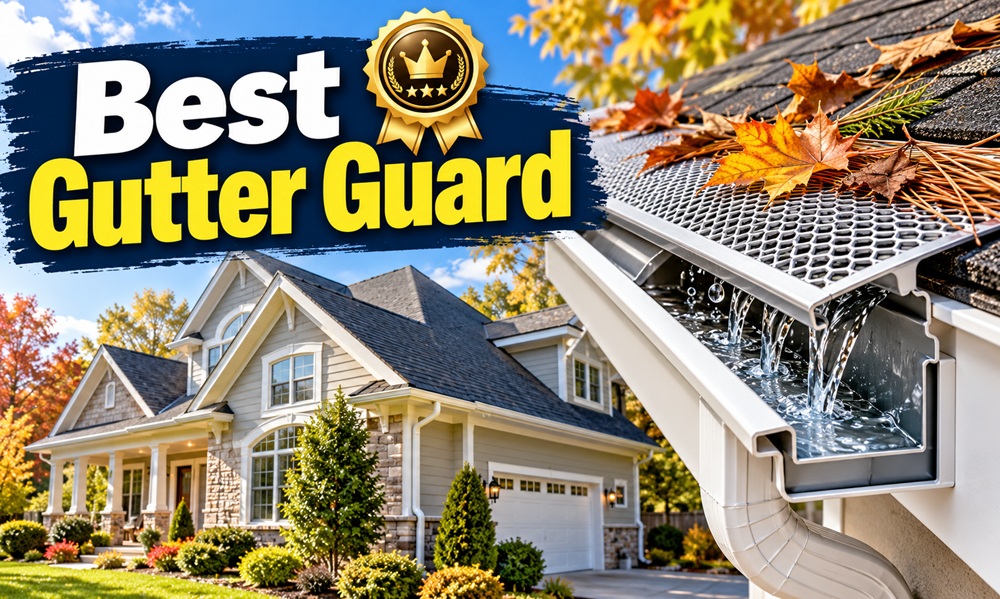
The best gutter guard is the one that matches what actually falls on your roof. For many homes with mixed tree debris, a well-installed stainless steel micro-mesh guard is a strong all-around choice, because its fine openings block leaves, needles, and most seeds. For homes that mainly deal with large leaves, a solid reverse curve guard or a sturdy screen can do the job at a lower price. Foam and brush inserts sit at the budget end, with more upkeep to go with it.
That’s the quick answer, but a ranking of products only helps if it fits your house. Two neighbors with the same guard can have very different results, so it’s worth understanding what separates a good fit from a poor one.
Start with what lands on your roof
Before comparing products, spend ten minutes outside after a windy day. Look at what’s collected in the gutters or on the roof edge. The debris tells you more than any buying guide.
Big, flat leaves from maples, oaks, and sycamores are the easiest to handle. Almost every guard keeps them out, and many shed them well.
Pine needles are the stubborn ones. They’re thin enough to slip through coarse screens and then lodge in the openings, which is why coarse screens often struggle under conifers.
Seeds, tiny blossoms, and helicopter-style samaras fall somewhere in between. They can pass through larger holes and settle on top of fine mesh, so the finer the screen, the better the result.
Shingle grit is the one most people forget. Asphalt roofs shed small granules into the gutter over the years, and fine mesh stops many of them while open designs let them through.
Best choices by situation
Heavy tree cover with mixed debris
Stainless micro-mesh is usually the strongest candidate. The screen is fine enough to block most small material, and a rigid frame keeps it from sagging. The trade-off is price and a bit of surface cleaning, since pollen and dirt can form a film. A quick rinse with a hose or a soft brush handles it.
Large leaves and moderate rain
A reverse curve guard works well here. Its solid top sheds leaves, and water follows the rounded edge into the slot. It’s less suited to extreme downpours, where fast water can leap past the opening, and to roofs steep enough to speed the flow.
Pine needles
Look at fine mesh first. Some reverse curve designs also handle needles reasonably well, though needles can collect on top and may need a sweep now and then. Avoid coarse perforated screens if you live under conifers.
A tight budget
Plastic or aluminum screens and foam inserts cost less up front. They can be a sensible choice for a small house with few trees. Expect to check them more often, and keep in mind that cheaper pieces may sag or warp over time.
Heavy rain regions
When storms dump water quickly, wide, open-surface designs like mesh tend to take in water across their full width, while solid hoods depend on a narrow slot. Whichever you choose, make sure the downspouts are large enough for the flow.
Snowy climates
Snow load matters. A rigid guard fastened securely holds up better than a thin one that can bend under weight. Remember that no guard prevents ice dams, which come from heat escaping through the roof, so insulation and attic ventilation still matter.
Comparing the main options
| Guard type | Strongest point | Weakest point |
|---|---|---|
| Stainless micro-mesh | Blocks small debris and grit | Higher cost, occasional surface rinse |
| Reverse curve | Sheds large leaves smoothly | Overshoot in heavy rain, installation precision |
| Perforated screen | Affordable and simple | Needles and seeds can stick in holes |
| Foam insert | Low cost, quick to place | Debris collects, may need replacing |
| Brush insert | Easy to install | Needles tangle in the bristles |
What makes one guard better than another
Product names change often, so it’s more useful to judge any guard by a few qualities rather than chasing a brand.
Material and frame come first. Stainless steel mesh in a rigid aluminum frame resists corrosion and sagging better than flimsy plastic. A frame that flexes in the wind or bows under snow won’t hold its shape for long.
Fit comes next. A guard needs to match the size and shape of your gutters, whether that’s a standard K-style or a half-round design. A mismatched guard leaves gaps where debris gets in or water slips out.
Attachment method matters too. Some guards slide under the first row of shingles, others fasten to the gutter lip or the fascia. Each method has pros and cons, and the wrong one for your roof can cause problems, so check your shingle warranty terms before committing.
Water handling is the heart of the matter. A good guard takes in water efficiently during a heavy storm instead of letting it skip over the front. Ask the installer how the product performs on your roof pitch, not just in general.
Finally, consider the warranty. Read what it covers, how long it lasts, whether it transfers when you sell, and whether it addresses clogging or only manufacturing defects. Claims like never clean again should make you cautious, because every guard eventually needs some attention.
What affects the cost
Prices vary a lot across regions and products, so any single number would be unreliable. The main drivers are the material, the length of gutter, the number of corners and downspouts, the height of the house, and whether you hire a company or install it yourself. Gutters that are sagging, leaking, or poorly pitched add repair costs on top.
When you gather quotes, ask for the product name, the footage, the warranty terms, and the installation method in writing. That makes it far easier to compare offers fairly.
DIY or professional installation
Some guards are made for homeowners. They clip, slide, or snap in place, and they suit single-story homes where you can work safely from a stable ladder. Others require precise angles, fastening under shingles, or work at height, and a professional is usually the better call for those. Ladder falls are a real danger, so the safest choice for a tall or steep house is often to hire someone with the right equipment.
Before any guard goes on, make sure the gutters themselves are in good shape. Fix leaks, tighten hangers, and confirm they slope toward the downspouts. Covering a problem doesn’t solve it.
Mistakes to avoid
Buying on price alone is the usual one. A cheap guard that clogs in a year costs more in the long run than a better one chosen with your trees in mind.
Ignoring your roof is another. A steep roof with a solid hood can overshoot, and a low-slope roof can hold debris on a flat screen.
Skipping the warranty details is easy to do when a salesperson is talking fast. Take the paperwork home and read it before signing.
Assuming a guard means zero maintenance is the last. A quick look after storms and again after the leaf season will catch problems early, and clearing the downspouts takes only a few minutes.
Making the final call
Write down your answers to a few simple questions. What kind of trees surround the house? How steep is the roof, and how tall is the house? How heavy does the rain get? What’s the budget, and who’s doing the installation? With those answers, the choice tends to narrow quickly. A fine stainless mesh suits most debris-heavy yards, a reverse curve fits leafy yards with modest rain, and a simple screen works for light conditions.
If you’re still unsure, have two or three local installers look at your house and explain why they favor a particular product. A good one will talk about your roof and your trees, not just their product line.