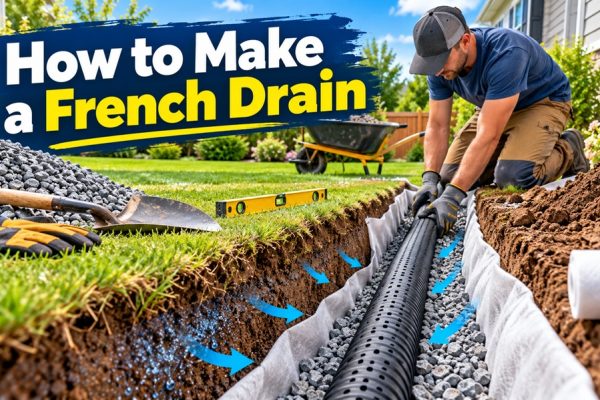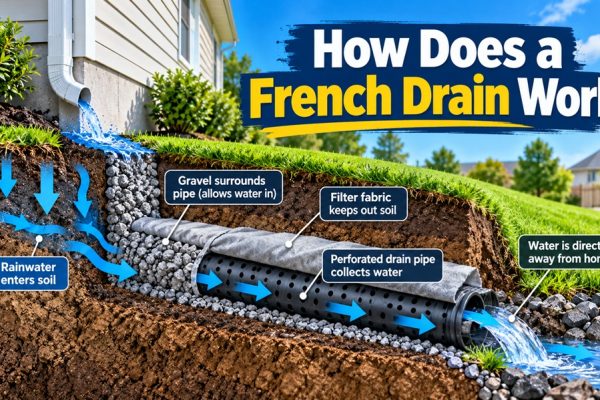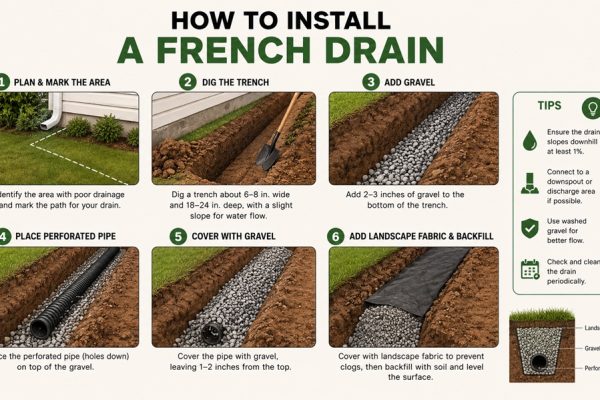
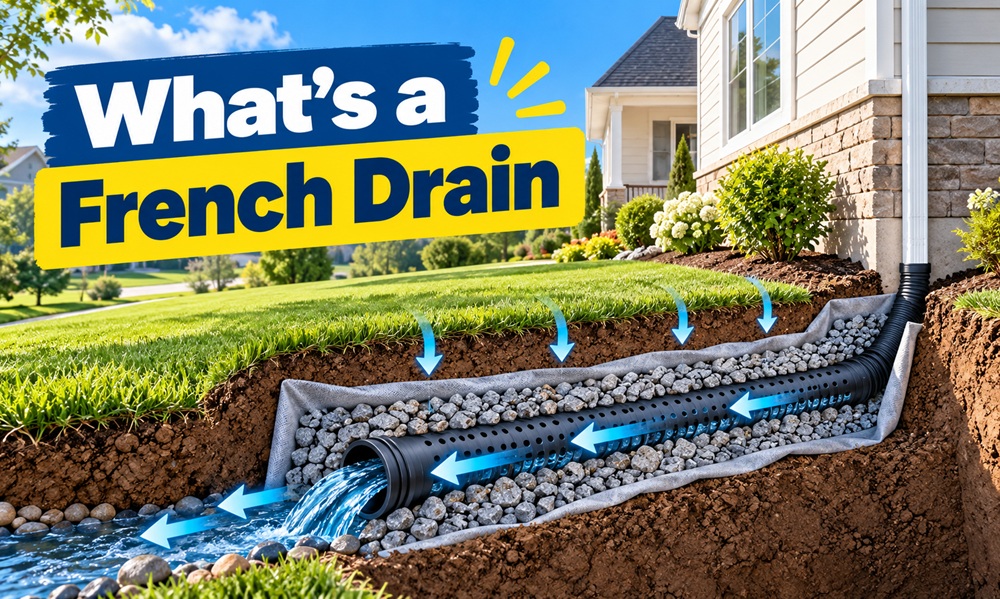
A French drain is a buried drainage line made from a trench, a layer of gravel, and a perforated pipe that carries water away from a wet area. Water seeps into the gravel, enters the pipe through its holes, and flows downhill to an exit point. Nothing about it is electric or mechanical. It relies on gravity and a gentle slope.
If you’ve landed here because a contractor, a neighbor, or a home inspection report used the term, that’s really all there is to the idea. The rest of this article covers where it came from, the versions you’ll hear about, and how to tell whether your property could benefit from one.
The name has nothing to do with France
The term is often traced to Henry Flagg French, a nineteenth-century Massachusetts writer who promoted drainage methods for farmland. The name stuck even though the technique itself is much older than his writing. Farmers have been burying stone-filled channels to dry out fields for a very long time. Today the same idea shows up in suburban backyards, around basements, behind retaining walls, and under athletic fields.
What’s inside the trench
A standard French drain has a few parts.
- A trench, usually narrow, dug at a slight slope
- Filter fabric that keeps soil from washing into the stone
- Clean gravel that gives water a fast path through the ground
- A perforated pipe laid inside the gravel
- An outlet where the water exits
The magic is in the contrast between materials. Water moves slowly through dense soil and quickly through open gravel, so it prefers the trench. The pipe speeds up that movement and carries it along the slope.
Types of French drains
The word covers a few variations, and knowing them helps when you’re reading a quote.
The standard yard drain
This is the classic version for lawns and landscaped areas. It’s fairly shallow, sits along the base of a slope or the edge of a soggy patch, and carries runoff toward a lower part of the property.
The curtain drain
A curtain drain is laid across a slope to intercept water before it reaches a house or a low area. It acts like a barrier, collecting the flow and redirecting it around the area you want to protect. It’s a common choice for homes built at the bottom of a hill.
The footing or perimeter drain
This version runs around the base of a foundation, below the level of a basement floor or crawl space. It’s often installed during construction, though it can be added to an existing home. Because of its depth and its relationship to the structure, retrofitting one is typically a job for a contractor.
The filter-free version
Some old-style drains have no pipe at all. They’re just trenches filled with stone. They can work in light conditions, but a pipe moves far more water and is the norm for modern installations.
Signs a French drain could help
Most people start looking into this after noticing a problem. A few common ones include:
- Standing water in the yard that lingers well after rain
- Soil that feels spongy or stays muddy for days
- Water pooling beside a foundation wall
- Damp spots along a retaining wall or at the base of a slope
- Grass that struggles or moss that thrives in one specific area
- Moisture or a musty smell in a basement or crawl space
Not all of these point to a French drain. Gutters that overflow, downspouts that dump water next to the house, and poor grading can all cause similar symptoms, and those are often cheaper to fix.
How it differs from other drains
People sometimes confuse French drains with other drainage options, so here are the distinctions in plain terms.
A French drain collects water from the surrounding soil. A catch basin or surface drain collects water from the surface through a grate, usually in a low spot in a driveway or lawn. A dry well is a buried chamber that stores water and lets it soak slowly into the ground, and it can serve as an outlet for a French drain. A sump pump removes water from a pit, usually inside a basement, by pushing it out with electric power.
Each of these tackles a different part of the same problem. A property with serious water trouble may use two or three together.
What affects the cost
Prices vary widely, so a single number wouldn’t be reliable. A few factors drive the total.
Length is the obvious one, since a longer trench means more digging, pipe, and gravel. Depth matters just as much. A shallow drain across a lawn is far simpler than a deep line beside a foundation. Access also plays a role, because tight side yards, steep slopes, and obstacles like trees, patios, and fences can slow the work and raise labor costs. Soil type affects digging difficulty, and rocky or heavy clay ground takes longer. The outlet makes a difference, too. Needing a dry well, a pop-up emitter, or a long run of solid pipe adds materials and time. Finally, the surface restoration counts, because replacing sod, concrete, or landscaping after digging adds to the bill.
For a realistic estimate, get written quotes from a few local drainage contractors and ask what each one includes.
DIY or professional
A short drain in a flat backyard is a manageable project if you’re comfortable with digging and have a good level. The important parts are the slope, the fabric, and the outlet. Mistakes in any of them can reduce how well the drain works.
Hire a professional when the drain will sit near a foundation, when water is already getting inside the house, or when the grading around the home looks like part of the problem. A professional can diagnose where the water is coming from, which isn’t always obvious. In some places you’ll also need to check local codes or permits, especially if the drain connects to a municipal system.
How long one lasts
There’s no single lifespan to quote, because it depends on the soil, the materials, and how well the drain was built. A line wrapped in proper fabric, surrounded by clean stone, and kept clear at the outlet can serve a property for many years. One built with dirty gravel or no filter can start losing capacity much sooner. Soil that carries a lot of fine silt, such as some clays, puts more stress on the system, which makes the fabric and the stone choice even more important.
If a drain has been quiet for years and the yard suddenly turns soggy again, that’s a hint the line may be partly blocked.
Limits worth knowing
A French drain is useful, but it isn’t a cure for everything. It can’t fix a sloped roof pouring water into one corner, a leaking pipe, or a yard that’s been graded toward the house. If the outlet has nowhere to go, the drain won’t empty. And clogged lines, whether from silt, roots, or crushed pipe, lose their effectiveness over time.
Regular checks help. Keep the outlet clear, watch it after storms, and avoid planting trees with aggressive roots nearby.
So, do you need one?
Think of it as a drain for water that’s already in the ground. If your problem comes from rain falling off the roof or sheeting across a paved surface, start with gutters, downspouts, and grading. If the soil itself stays saturated, and there’s a place for the water to go, a French drain is worth a serious look. A conversation with a local drainage contractor can usually settle the question in a single visit.