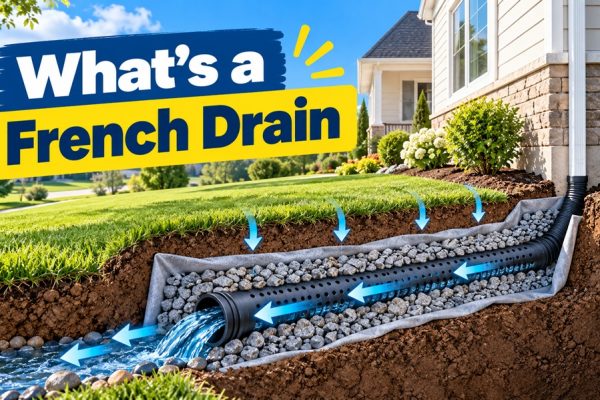
Water in a yard doesn’t behave the way it does in a bucket. It soaks into soil, creeps sideways, pools wherever the ground dips, and sits there until something gives it an easier route. That’s exactly what a French drain does. It’s a gravel-filled trench with a perforated pipe inside, set at a gentle downward slope, and it collects groundwater and surface runoff before carrying it to a spot where it can drain without causing trouble.
That’s the short version. The longer version is worth knowing, because a French drain designed around how water really moves can serve a property for years, while one that ignores those basics can clog, back up, or simply move the puddle ten feet to the left.
Why water gathers in the first place
Soil holds water in the tiny spaces between its particles. Sandy soil lets water pass through quickly. Clay soil clings to it and drains slowly, which is why clay-heavy yards can stay soggy for days after a storm. Once the ground is saturated, extra rain has nowhere to go. It sits on the surface or pushes sideways through the soil toward lower areas, and those lower areas are often a foundation wall or the far corner of the lawn.
A French drain doesn’t stop rain from falling, and it doesn’t make the surrounding soil drain faster. What it does is create a path of least resistance. Gravel has large gaps between its pieces, so water moves through it far more easily than through packed dirt. When groundwater reaches the edge of the trench, it tends to flow into the stone instead of continuing through the denser soil around it.
The parts that make it work
Every piece of the system has a job, and leaving one out is where most failures begin.
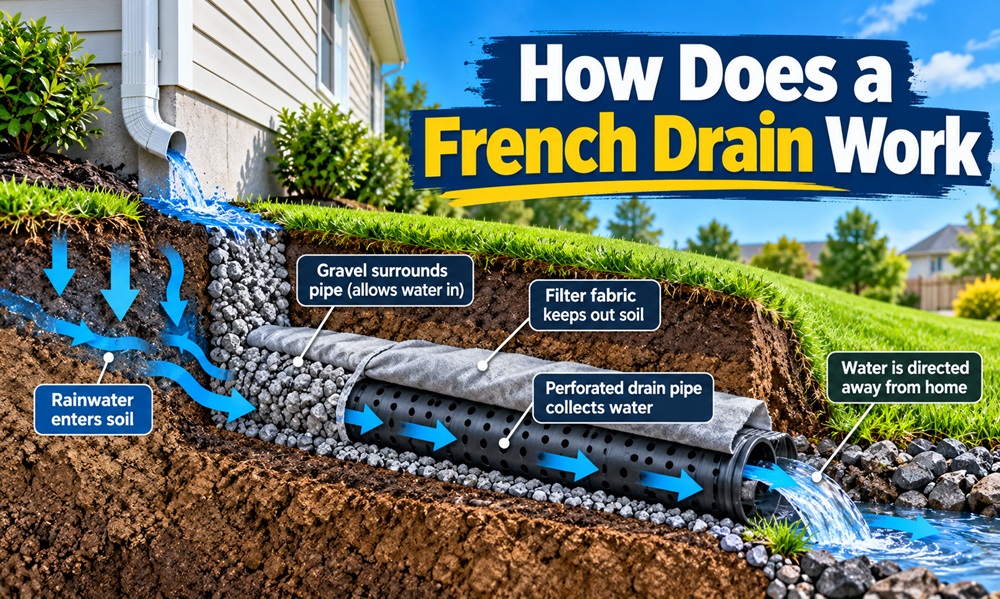
- The trench is dug along the line where water collects or along the edge of the area you want to keep dry. Its width and depth depend on how much water you’re dealing with and what the soil is like.
- Landscape fabric lines the trench so soil particles stay out of the gravel. Without it, fine silt slowly works its way in and fills the gaps that water needs to travel through.
- Clean, washed gravel is the usual fill because it contains little fine dust that could settle and clog. The stone is the first thing the water meets.
- A perforated pipe runs through the gravel. Water enters through the slots or holes and flows along the pipe, which moves it much faster than it would travel through stone alone.
- The outlet is where the pipe ends. Common choices include a lower part of the property, a pop-up emitter, a dry well, or a storm drain connection where local rules allow it.
What happens during a rainstorm
Picture a heavy storm on a sloped backyard with a French drain running along the base of the slope. Rain soaks the upper yard. As the soil fills up, water starts moving downhill, partly over the surface and partly just beneath it. When that water meets the trench, the gravel gives it an easy way in. It drops through the stone and reaches the pipe, and from there gravity pulls it toward the outlet.
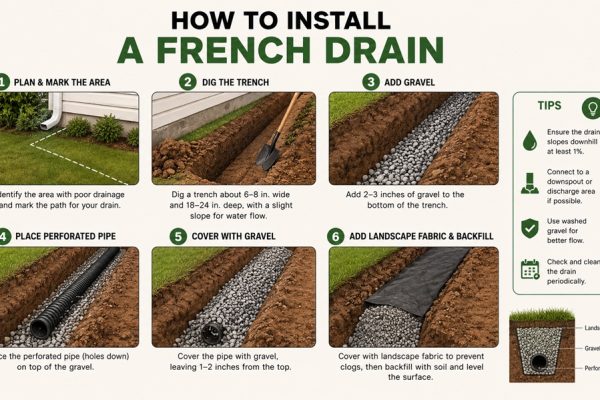
Two things matter in that sequence. The first is location. The trench has to intercept the water, so a beautifully built drain in the wrong spot will sit nearly dry while the problem area stays wet. The second is slope. Water moves through a pipe because one end is lower than the other. A commonly cited guideline is a drop of about one percent, which comes to roughly an eighth of an inch per foot of pipe, although your pipe manufacturer or a local contractor can tell you what suits your site.
Surface drains and deeper drains
People use the same name for two slightly different setups, and the difference changes how the drain works.
A shallow drain sits near the top of the ground. Sometimes the gravel is visible at the surface, and sometimes it’s covered with a thin layer of soil or decorative stone. Its main job is catching runoff that sheets across the yard, which is why you often find it in flat, soggy lawns.
A deeper drain sits well below the surface and mainly intercepts groundwater before it presses against a basement wall. When it runs alongside a foundation it’s usually called a footing drain or perimeter drain. The principle is identical, but the depth, the pipe placement, and the stakes are quite different. Work next to a foundation is often handled by a contractor, since a mistake there can affect the building itself.
Which way the pipe holes should face
This detail gets debated more than you’d expect. Many installers lay the pipe with the holes facing down, so water enters from the bottom and the pipe behaves like a channel once it fills. Others set the holes facing up, reasoning that water rises into the pipe from the surrounding gravel when the trench is full. Neither choice is universally right, and some pipe products are built with a specific orientation in mind. Follow the instructions that come with the pipe you buy.
Why French drains stop working
A French drain is a passive system with no moving parts, so when it fails the cause is usually one of a few things.
Clogging is the most common. If fabric was skipped or wrapped badly, fine soil migrates into the gravel over time. Tree and shrub roots can also grow toward the moisture and into the pipe, especially near older installations.
Poor slope comes next. If sections of pipe sag or sit level, water collects inside instead of moving along. That standing water holds sediment and can make a small clog bigger.
A blocked or badly planned outlet is another culprit. If the pipe empties into ground that’s already saturated, the water has nowhere to go and the whole line backs up. The outlet needs a real destination with enough capacity to take what the drain delivers.
Finally, a drain can simply be too small for the job. A large roof sending water to one corner, a high water table, or a series of heavy storms can overwhelm a system designed for lighter conditions.
How it compares with other ways to handle water
A French drain isn’t the right tool for every wet spot. This comparison shows where it fits.
| Approach | Where it works well | Where it falls short |
|---|---|---|
| French drain | Collecting shallow groundwater and runoff along a line | Needs a workable slope and an outlet |
| Surface swale | Redirecting water that flows across the ground | Doesn’t deal with water below the surface |
| Dry well | Holding collected water and releasing it slowly into the soil | Struggles in heavy clay or where the water table is high |
| Downspout extensions | Carrying roof water away from the house | Does nothing about groundwater |
Keeping a French drain working
Because the system is hidden, it’s easy to forget until something goes wrong. A little attention helps. After a heavy rain, check the outlet to see whether water is flowing out. A trickle that never appears, even when the yard is wet, suggests a blockage somewhere along the line. Keep the outlet clear of leaves, mulch, and sediment, and keep an eye on any pop-up emitter to make sure it opens freely.
Keep trees and shrubs with aggressive roots well away from the pipe. If you suspect a clog, a drainage contractor can often flush the line or inspect it with a small camera.
When it’s time to call a professional
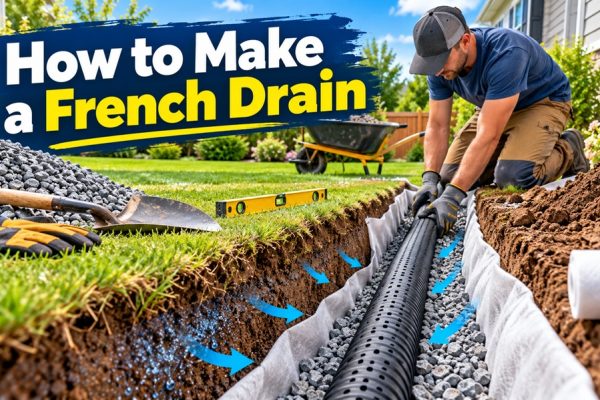
A short drain that moves water across a flat lawn is within reach of a confident DIYer. A drain that protects a foundation, handles a serious basement leak, or has to cross a property line or connect to a municipal system is a different story. Local codes may govern where water is allowed to go, and some areas require permits. Buried utilities are also a real concern, so anyone digging should have lines marked before the first shovel goes in.
A professional can also tell you whether a French drain is even the right answer. Sometimes the real fix is grading the soil away from the house, repairing a gutter, or adding a sump pump, and a good contractor will say so.
The takeaway
A French drain works by giving water an easier path than the soil offers. Gravel catches it, a sloped perforated pipe moves it, and a well-chosen outlet lets it go. When the trench sits where the water actually travels, the pipe has enough slope, and the fabric keeps the gravel clean, the system can quietly handle problems that would otherwise keep a yard wet for days.